Home > SUNTABA®
|
貼霸SUNTABA®
|
| ||||||
|
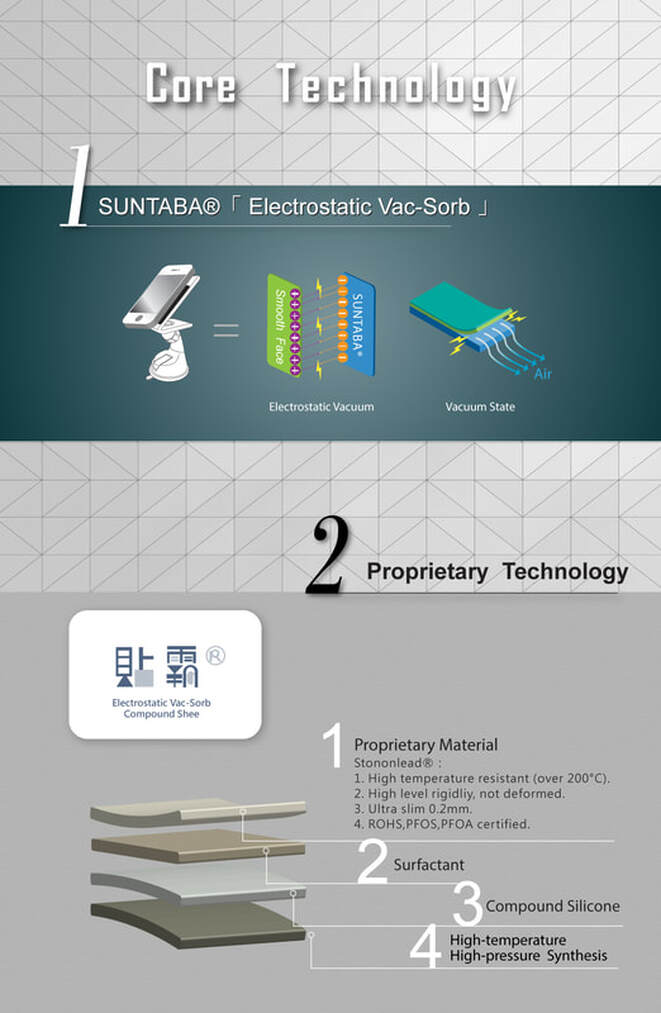
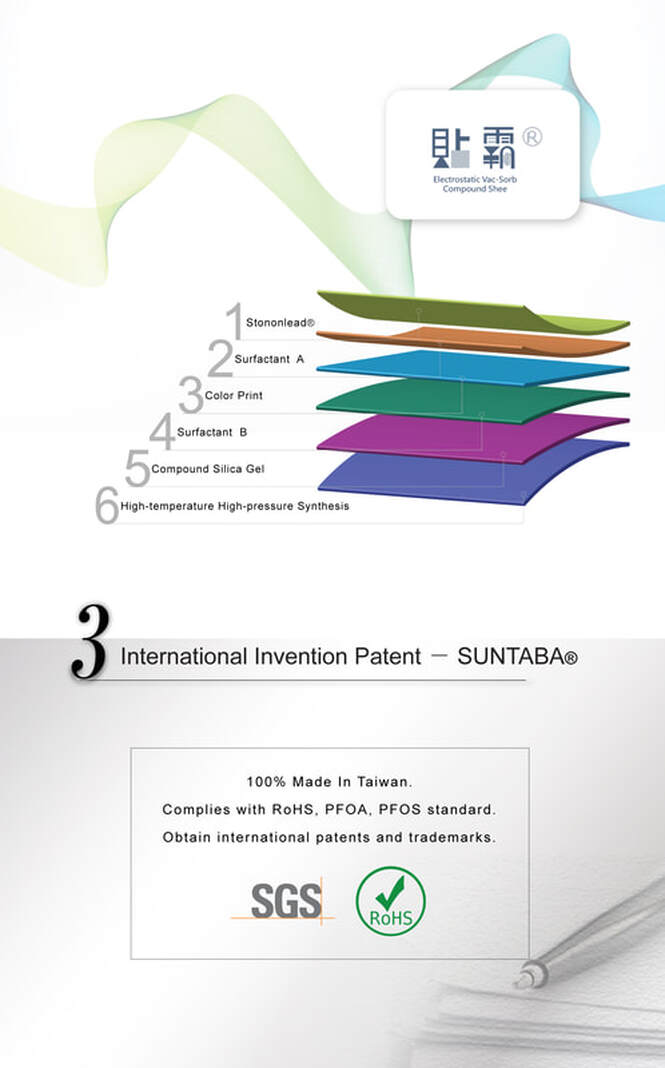
In 2010, Sunny Process’s R&D team successfully combined silicone with high-temperature materials to develop an eco-friendly vacuum adsorption material – SUNTABA® – capable of withstanding temperatures up to 280 °C and reusable over 1,000 times.
This innovation replaced the traditional tape-fixation method, allowing PCBs to be firmly secured on carriers without external pneumatic sources. It solved production line contamination and labor-intensive issues, thereby advancing automated manufacturing. |
In 2020, SUNTABA® technology was further optimized to meet the needs of semiconductor and electronic packaging processes. With improved flatness and repeatability of adsorption, it has been widely applied in wafer grinding, chip thinning, and carrier fixation for packaging. It has become a key material solution for non-destructive fixation in high-precision processes.
「貼霸®」符合SGS的RoHS 2.0、PFOS、PFOA、無鹵的環保檢測。
CORE ADSORPTION PRINCIPLE
SUNTABA® integrates Van der Waals Force and Vacuum Suction, enabling stable fixation of flexible substrates and thin materials even without external pneumatic sources. This enhances stability and precision in electronic manufacturing processes.
|
✅ Van Der Waals Force — The Starting Point of Microscopic Adsorption
“Microscopic adsorption without trace — molecular attraction ensures firm adhesion, leaving no damage and no residue.” The silicone surface of SUNTABA® provides an ultra-fine contact interface. When in contact with wafers or substrates, intermolecular Van der Waals forces are generated, creating a weak yet stable adsorption effect even without external force. This is a physical, non-destructive form of adsorption, leaving no adhesive residue and making it suitable for high-cleanliness processes. |
|
✅ Vacuum Suction — The Key to Controllable Adsorption and Release
“Instant adhesion, firmly secured; instant release, perfectly restored.” SUNTABA® employs a high-elasticity silicone layer combined with a sealed underlying structure. When external pressure is applied, the silicone conforms to the surface of the chip or substrate, creating localized low-pressure zones (vacuum chambers) that enhance the adsorption effect. Once the vacuum is released, the material immediately returns to its original state, achieving non-destructive and repeatable adsorption. |
|
✅ Even Pressure Hold — Guarantee of High-Flatness Processing
“Steady as a rock, flat without distortion — every contact point bears just the right amount of pressure.” Through patented design, SUNTABA® provides uniform contact surfaces and adsorption pressure, ensuring that chips remain free from warpage or slippage, while withstanding lateral forces during grinding and polishing processes. This is particularly critical for precision operations such as wafer grinding and thinning, where thickness must be controlled to 200 μm ± 5 μm. |
|
✅ Surface Optimization — Optimized Contact Interface
“Every adsorption is a calculated fit.” The surface of SUNTABA® can be engineered with microstructures to enhance gas dissipation and surface conformity, preventing bubble residue or micro-displacement risks, and ensuring stable adsorption performance. |
Core Principle |
Mechanism |
Effect |
Van der Waals Force |
Microscopic intermolecular adsorption force. |
No adhesive residue, non-destructive adsorption. |
Vacuum Suction |
Localized vacuum forming adsorption chambers. |
Controllable adsorption and release, stable fixation. |
Even Pressure Hold |
Elastic structure distributes pressure evenly. |
Prevents warpage, protects chips |
Surface Optimization |
Microstructure design enhances gas dissipation and conformity. |
More stable adsorption, prevents displacement. |
Applications of SUNTABA
|
Features of SUNTABA
|
| ||||||
SUNTABA Storage and Usage Instructions
To ensure stable material performance and extend the service life of SUNTABA, please follow the guidelines below:
- Storage Temperature:Store in an environment below 25 °C. Avoid high temperatures that may cause degradation of adhesive properties.
- Recommended Usage Period:Apply to jigs/fixtures within 3 months. Beyond this period, adhesive strength of the backing layer may be affected.
- Surface Condition:The material surface should remain glossy and clean. Dust, oil, or foreign matter will reduce vacuum adsorption efficiency.
- Avoid Stacking Contact:After use, store flat and avoid direct contact between materials to prevent indentations or deformation.
- Prevent Heavy Pressure:During storage or transport, avoid compression or heavy loads that may cause indentations and affect machining accuracy.
- Cleaning Method:Rinse with water or neutral detergent, or use peel-off cleaning rollers for maintenance.
- ⚠️Do not use strong acid/alkaline cleaners or rough cloths for wiping, as they may damage the surface of SUNTABA.
SUNTABA Testing
-
Ejecting Force Test
-
Acid and Alkali Resistance Test
-
Lifetime Test
-
ESD & Surface Resistance Test
-
ASTM E595 Test
-
Tensile & Initial Force Test
-
Vertical Tensile Test
<
>
|
SUNTABA T0 -- Ejecting Force Test Results
|
SUNTABA T2 -- Ejecting Force Test Results
|
|
Suntaba Acid and Alkali Resistance Test
DIP TIME:1 HR
|
suntaba T2 lifetime test
|
( cold and hot shock test 1500 cycles )
Test method : SUNTABA T2 is heated at high temperature and pressed down on the "contact material" for 5 minutes, then cooled down and removed from the "contact material". This is repeated over many cycles.
|
|
Test result : After 1,500 hot and cold shocks, the SUNTABA T2 still has adsorption effects, and impurities are found on the surface (which can be cleaned with alcohol wipe).
| 貼霸T2__冷熱衝擊1500測試.pdf | |
| File Size: | 1724 kb |
| File Type: | |
suntaba vacUum pallets (T0/T2) surface resistance & esd test
Surface Resistance:SUNTABA TO → 10E12 Ω ; SUNTABA T2 → 10E5 Ω.
STATIC ELECTRICITY:SUNTABA TO → 0.02 KV ; SUNTABA T2 → 0.06 KV.
※ Because the bottom Stononlead® is ESD material, it can improve the static electricity of the whole Suntaba Vacuum Pallets.
SUNTABA VACUUM PALLETS (T0 / T2) complies with ESDS MM CLASS M1 level standards.
SUNTABA ASTM E595 OUTGASSING IN VACUUM ENVIRONMENT TEST
| ASTM E595 Outgassing In Vacuum Environment Test.pdf | |
| File Size: | 295 kb |
| File Type: | |
TEST ITEM |
TEST RESULTS |
STANDARDS |
TML (Total Mass Loss) |
0.580 % |
≦ 1% |
CVCM (Collected Volatile Condensable Materials) |
0.316 % |
≦ 0.1% |
WVR (Water Vapor Regained) |
0.078 % |
- |
SUNTABA Tensile Test
SUNTABA T0 was adhered to a 1 mm-thick PCB board. A peel test was conducted at 200 mm/min to lift the SUNTABA, measuring the required force before and after reflow.
Test Conditions:23°C ± 2, 50% ± 2% RH
SUNTABA® Initial Force Test
SUNTABA Vertical Tensile Test
SUNTABA was used to adsorb quartz glass (1.1 × 12 × 12 mm). The test measured the force required to pull the glass off vertically.
|
|